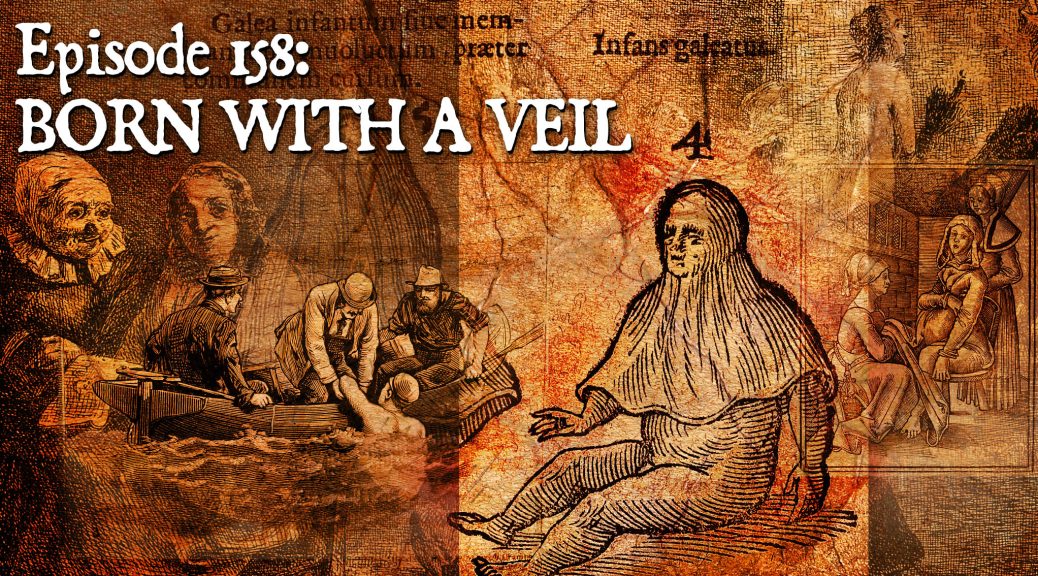
Born with a Veil
Podcast: Play in new window | Download (Duration: 38:37 — 44.2MB)
Subscribe: Apple Podcasts | Spotify | Android | Podchaser | RSS | More
To be “born with a veil” (or caul) was once regarded as far more than an unusual circumstance of birth. Being born with a caul—a portion of the amniotic membrane adhering to a newborn’s head or face—is exceedingly rare, but across centuries of European folklore it has been interpreted as a visible mark of destiny. Those born with one might be exceptionally lucky, possess healing powers or second sight, or enjoy supernatural protection. In darker traditions, however, the same sign could mark a future witch, vampire, or uncanny wanderer between worlds.
We begin with a quoted passage from Stephen King’s The Shining, in which it’s revealed that the psychically gifted boy, Danny, is born with a veil and then go on to explore the colorful vocabulary once used to describe the caul. Across Europe, the membrane was imagined as a cap, hood, helmet, veil, cloak, or even a “shirt.” Such expressions as the Scottish “sely hoo,” or blessed hood, and various European equivalents of “lucky cap” and “victor’s cloak” reveal how closely the caul became associated with good fortune.
Next, we explore the earliest written references to caul superstition. A fourth-century biography of the short-lived Roman emperor Diadumenian claims that he was born with a strange membrane resembling a diadem. The same source remarks that midwives sold preserved cauls to lawyers who believed they would bring success in court. Medieval clerical writings likewise condemn officials who carried cauls as charms to silence their opponents.
From there, the episode turns to the long practice of preserving cauls as family treasures. Surviving examples include a fragment enclosed in a locket made for John Monson in 1597 and the caul of King Frederik III, kept in a silver casket in the Danish royal collections. Seventeenth-century wills describe cauls mounted in jeweled gold settings and passed down as heirlooms believed to ensure a family’s continuing prosperity.
We then address the caul’s most famous power: protection from drowning. By the eighteenth century, cauls were carefully dried on paper and sold to sailors. Newspaper advertisements addressed “gentlemen of the Navy” and offered them as proven safeguards for long voyages. Dickens satirized the trade in the opening of David Copperfield, whose caul attracts only one bidder—an attorney offering cash and sherry, but refusing to pay enough to guarantee himself against drowning.
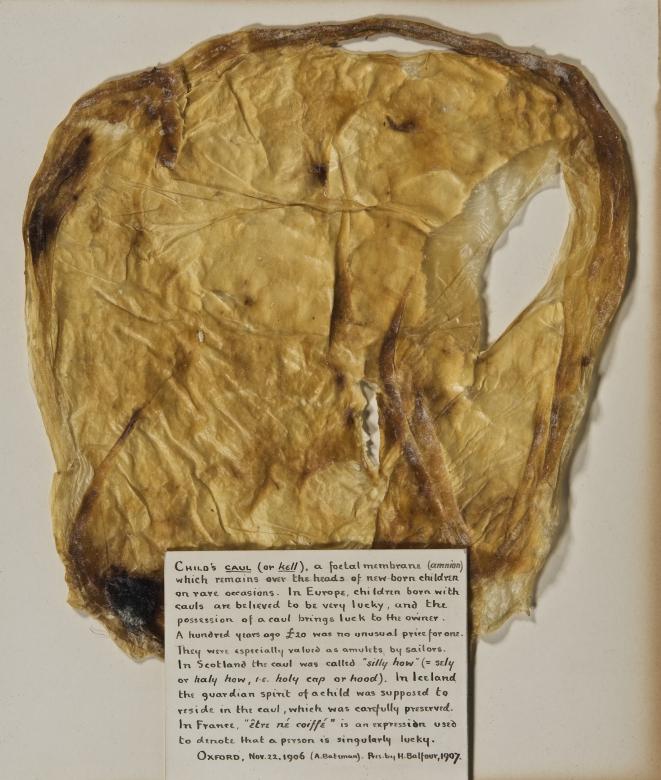
Mrs. Karswell then shares some amusing 19th-century anecdotes found in the long-running Oxford University publication, Notes and Queries. One report has a caul-bearing child who hild floated like a cork whenever his mother tried to bathe him. Another describes a prognosticating caul that physically transformed in sympathy to events unfolding in the life of the person consulting it.
We then travel to Iceland, where fetal membranes were associated with the fylgja, a guardian spirit or external portion of the soul. The afterbirth could not safely be discarded, exposed to animals, or burned, lest the child lose this spiritual companion. Yet the caul’s magical potential also made it dangerous: witches were said to use it in love potions, and a seventeenth-century French royal midwife warned her colleagues never to preserve one because sorcerers might obtain it.
The episode then moves eastward, where caul folklore grows considerably darker. In Romania and Poland, those born beneath the membrane might be destined to become strigoi or other vampiric beings after death. In Slovenia, Croatia, and Serbia, however, caul-born men could become supernatural defenders known as Krsniki or Zduhaći. Their spirits left their bodies at night to battle dragons, witches, night-hags, and rival spirit warriors threatening the community’s health, weather, and harvest.
Next, we encounter their Italian counterparts, the Friulian Benandanti, or “good walkers.” Sixteenth- and seventeenth-century inquisitorial records describe men and women who claimed that everyone born with a caul was summoned in adulthood to fight witches during nocturnal spirit journeys. Their preserved “little shirts” were worn around the neck, blessed with prayers and Masses, and believed to protect soldiers or help lawyers win cases.
Finally, we return to the sea with the curious modern discovery of a preserved caul purportedly belonging to a survivor of the the sinking of the Titanic. Its provenance may be uncertain, but the topic at least provides an excuse to close out with a snippet of the uniquely grim yet lighthearted folk song, “When the Great Ship Went Down.”