Tag: Normandy

Robert the Devil: Medieval Legend, Gothic Opera

Robert the Devil: Medieval Legend, Gothic Opera

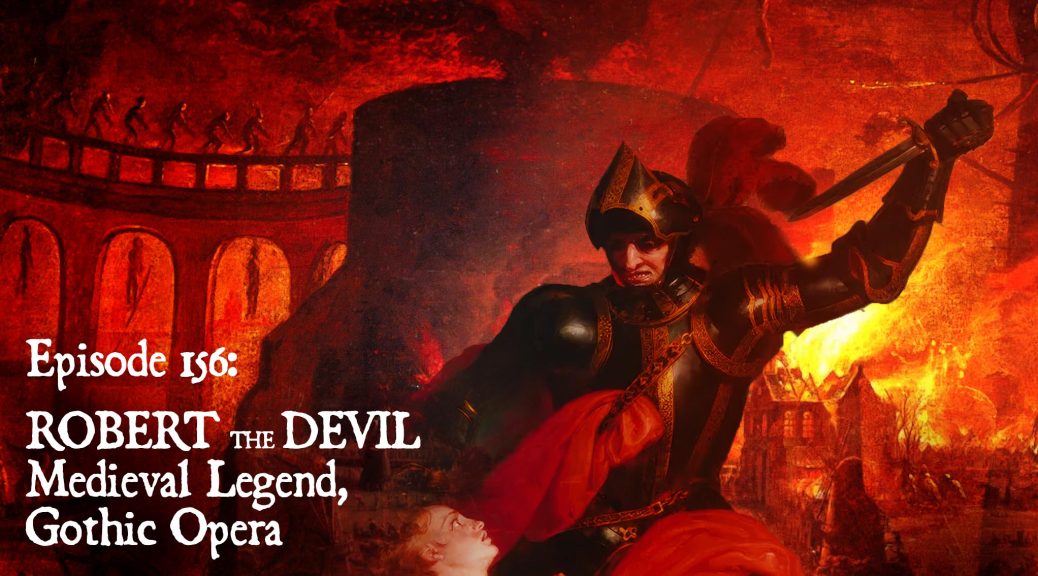
Robert the Devil is a supernatural medieval legend that inspired a 19th-century French opera, which incorporates key elements from a seminal Gothic novel.  The opera and legend are substantially different but both interesting.

We begin with Giacomo Meyerbeer’s 1831 opera, Robert le diable, which gained notoriety for a ballet sequence in Act III, which portrays an attempted seduction of the hero, Robert, Duke of Normandy, by the ghosts of corrupted nuns, freshly risen from their crypts. The scene is not found in the original legend, but as we learn, was borrowed from a particularly sensationalistic early Gothic novel,The Monk, written by Matthew Gregory Lewis in 1764.   We also learn that Meyerbeer’s chief librettist, Eugène Scribe later went on to crib another storyline from Lewis’ The Monk for the 1854 opera by composer Charles Gounod, La nonne sanglante (“the bloody nun”).
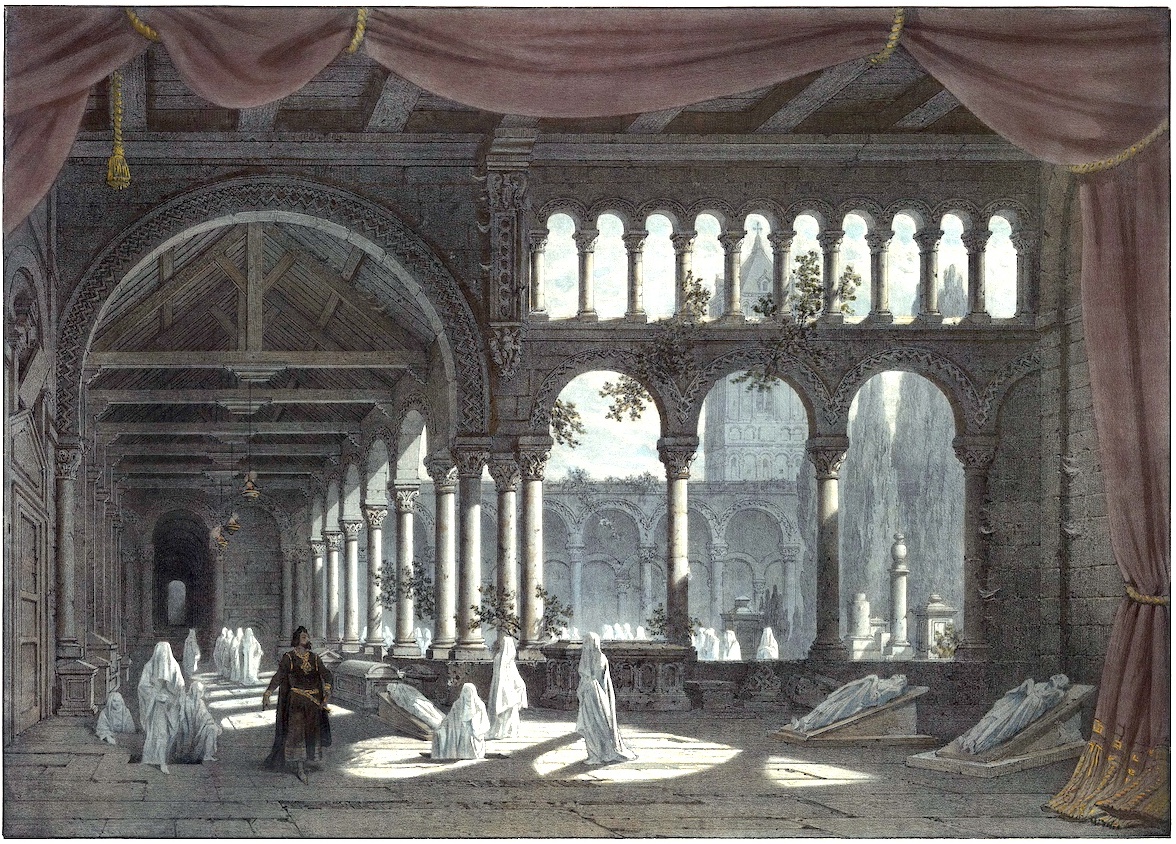
Rendering of cloister set for Paris Opera premiere.

Along the way, we learn how Robert le diable helped save the financially imperiled Paris Opera after its royal subsidy had been withdrawn following the July Revolution of 1830.  Along with public curiosity about the scandalous ballet, ticket sales owed much to the 19th-century equivalent of special effects — flashy and innovative stagecraft (new gaslight design, trapdoors, floating will-o-the-wisps, etc.) and a spectacular set replicating a ruined gothic monastery. Hans Christian Andersen, George Sand and Frédéric Chopin lavishly praised the production. Honoré de Balzac and Alexander Dumas worked mentions of the opera into their novels. Edgar Degas painted not one but two renderings of the Ballet of the Nuns.
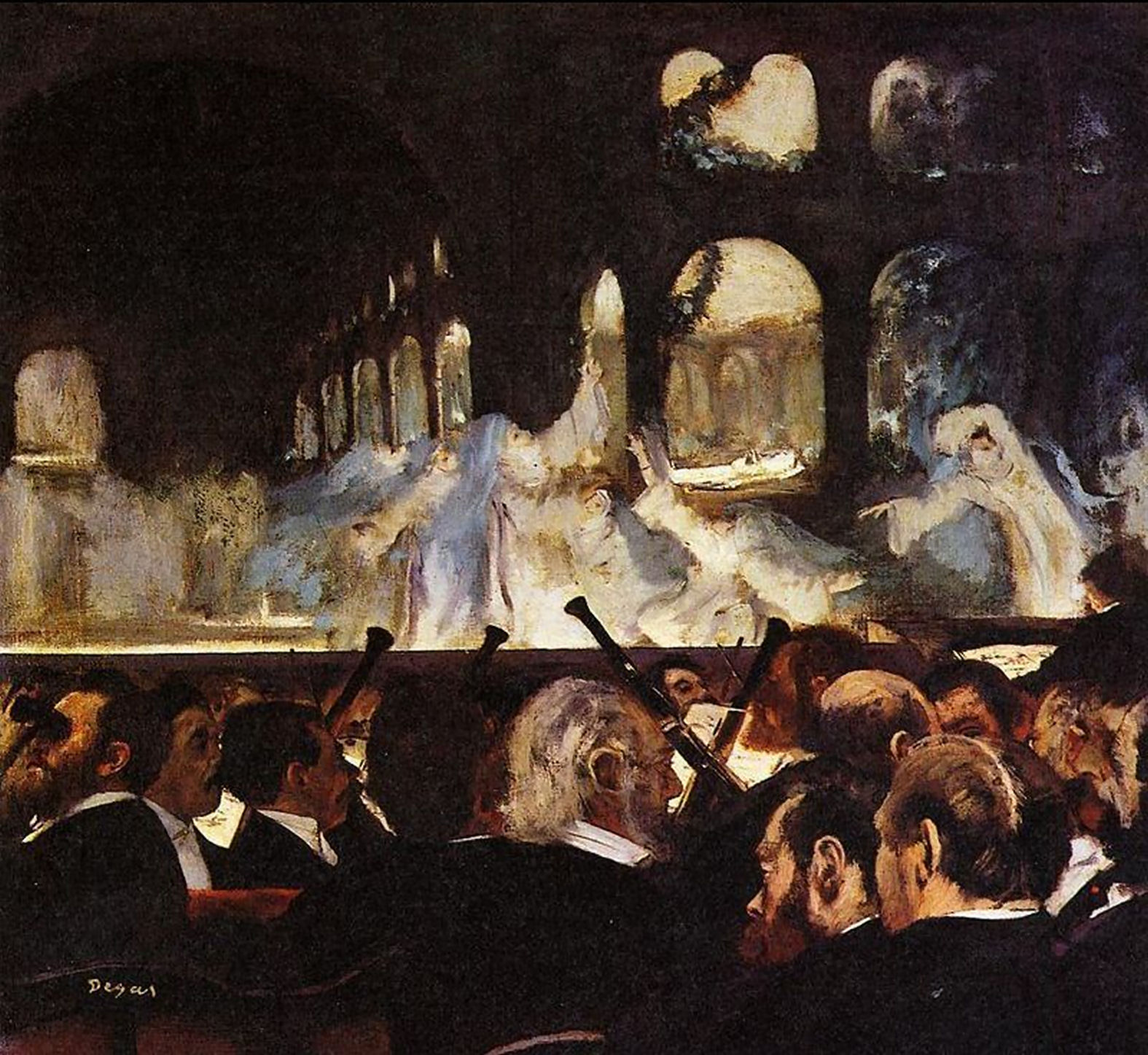
Edgar Degas’ rendering of the “Ballet of the Nins”

The opera also gave birth to a new style of ballet, one linked to Romanticism’s interest in the supernatural: ballet blanc, “white ballet” named for the innovative long, flowing skirts that lent themselves to wafting movements suggestive of misty wisps moving in the darkness. The opera’s 1847  London premiere was attended by Queen Victoria and featured superstar soprano Jenny Lind as Robert’s sister.  Traffic came to a standstill as unruly spectators mobbed the streets hoping for  glimpse of either celebrity.

The second half of our episode tells the original story of Robert the Devil.  It first appeared around 1250, sketched out in short form by the Dominican monk, Étienne de Bourbon, in a collection of exempla, or moral tales intended to be used by priests in their homilies.  A couple decades later, details were filled out in a longer, anonymous  poem, preserved in France’s National Library. Then by the late 14th century, it was rendered as a miracle play in “Forty Miracles of Our Lady,” commissioned by a guild of Parisian goldsmiths. By 1500, the story had arrived in Britain. That year, Wynkyn de Worde, assistant to pioneering London printshop owner Thomas Caxton, issued a chapbook prose translation hewing close to the French 14th-century poem.

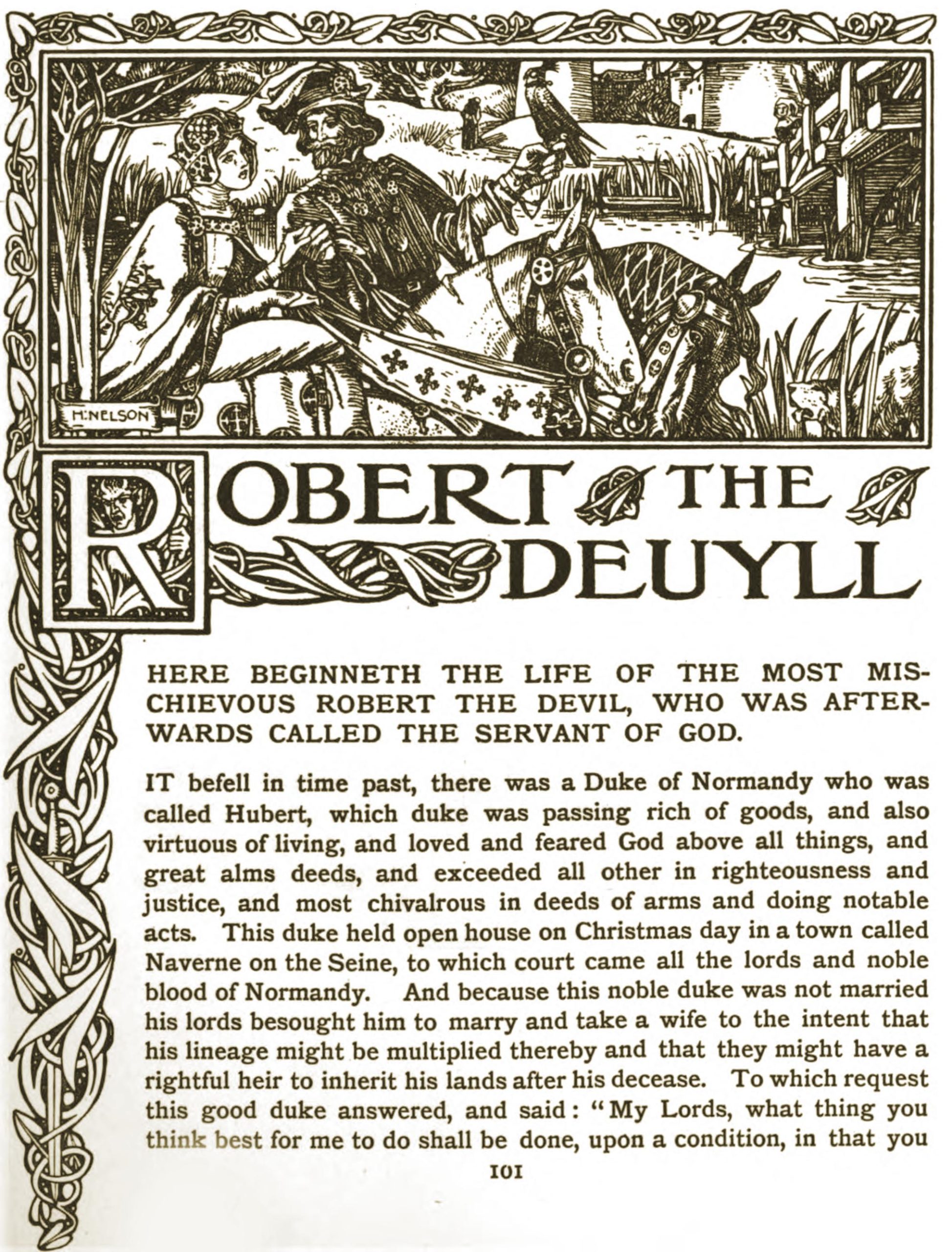
I found the Wynkyn de Worde text reproduced in a handsome 1904 volume complete with line illustrations, decorative initials, and borders reminiscent of the Arts and Crafts books of William Morris.  As promised in the episode, here is the link to that book: Robert_the_Deuyll.pdf.  (Visit the show notes on the Bone and Sickle website if you can’t click link).

As for the  story itself, it’s best you enjoy it without spoilers as told by Mrs. Karswell.  It’s full of demonic wrath, battles, court intrigue, miracles, pathos, and a very and prolonged peculiar penance.  All told in charming 16th-century language with all the little sound-design extras you’ve come to expect from Bone and Sickle.
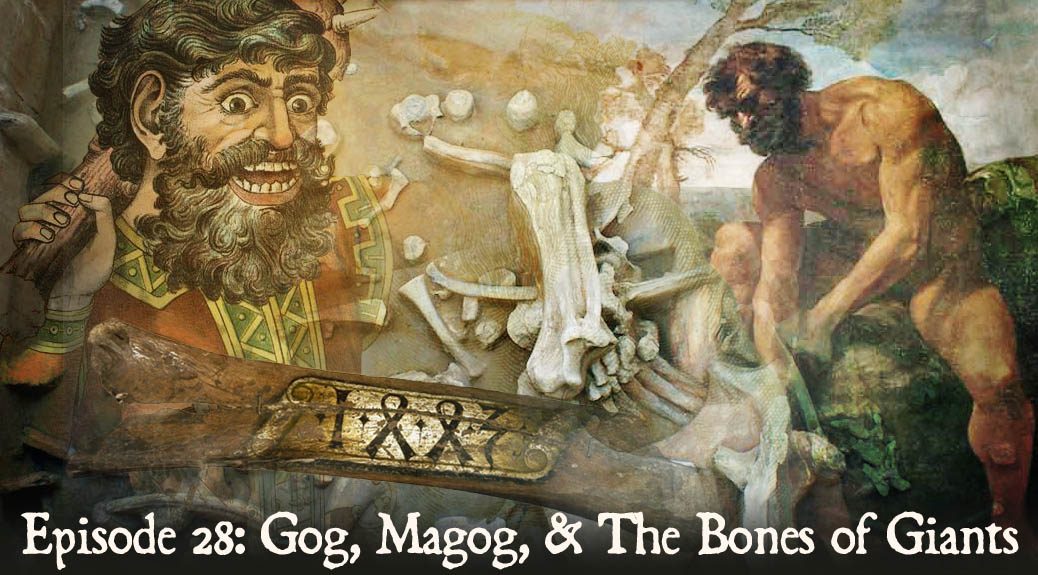
#28 Gog, Magog, and the Bones of Giants

#28 Gog, Magog, and the Bones of Giants

This time we look at the myths of British giants Gog and Magog, and a belief in biblical giants seemingly confirmed by giant bones dug from the earth.

We begin with a 1953 newsreel welcoming reconstructed figures of Gog and Magog back to the London Guildhall after the Nazi bombing of the city destroyed the originals. While Londoners may know the figures as those paraded in the Lord Mayor’s show each November, we also look at a more American perspective on Gog and Magog as figures representing nations allied with the Antichrist from the biblical book of Revelation.

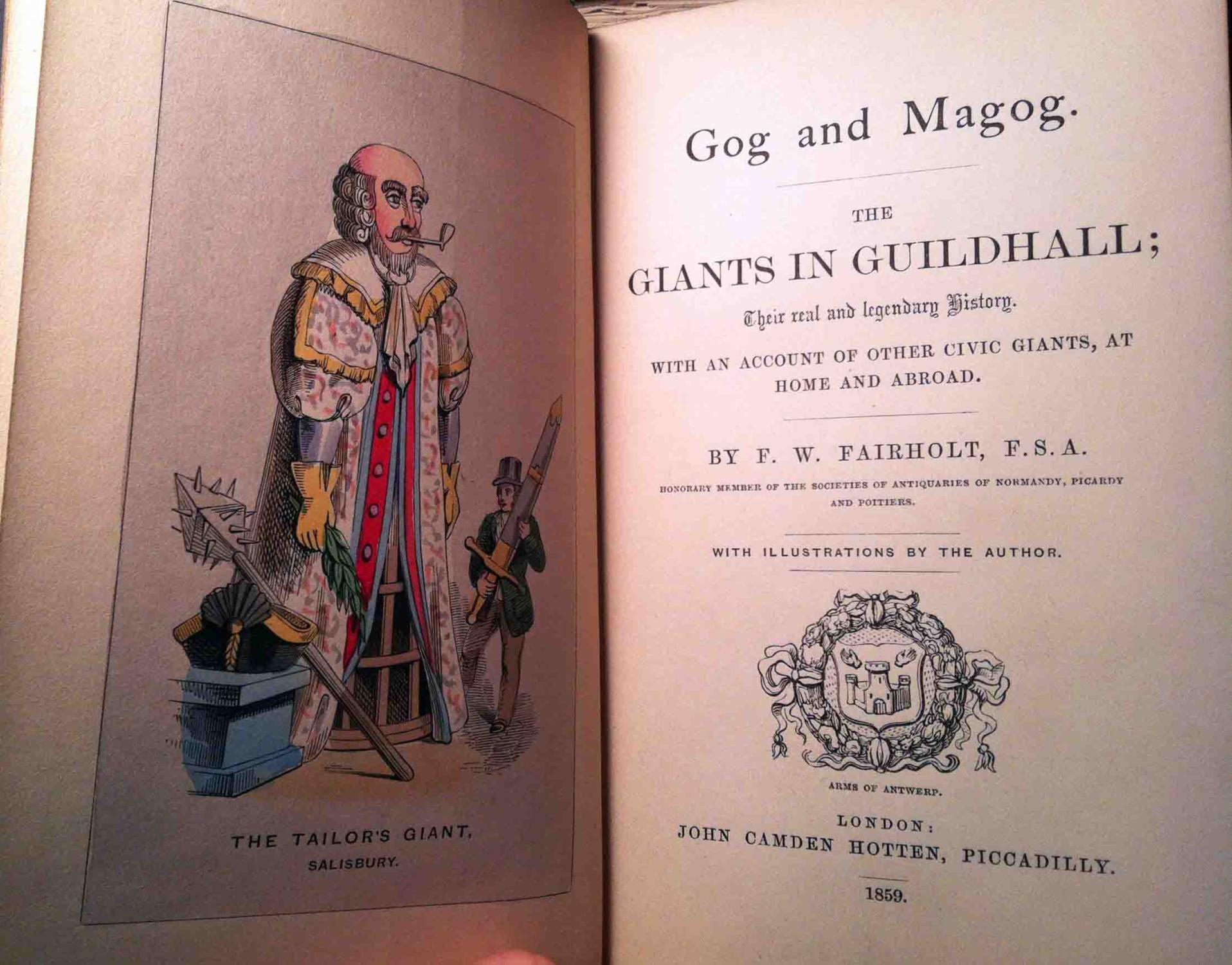
A book quoted in the show.

Our next stop in the Bible is a verse from Genesis Chapter 6, speaking of “giants in the earth in those days,” (before the Flood).  The word “giant,” we learn, was chosen to translate the Hebrew “Nephilim.”  Our Genesis passage suggests the Nephilim are the offspring of angels mating with human women, and this notion is reinforced by apocryphal texts, such as the Book of Enoch, which dubs these fallen angels “Watchers.” We hear a snippet featuring kindly Watchers from Darren Aronofsky’s 2014 film, Noah, which whitewashes the traditional understandings of the Watchers.

The word, “Nephilim,” we learn, literally means “fallen ones,” (“fallen” as in divine beings tainted by human hybridization.)  The suggestion that they are physically large comes from another Genesis story in which Moses sends spies to the land of Canaan in preparation for a Hebrew invasion and receives a report on “Nephilim” who in size compare to men as men do to grasshoppers.  We also hear some amusing stories of the biblical King Og, whose 13-foot bed is mentioned in the book of Deuteronomy.

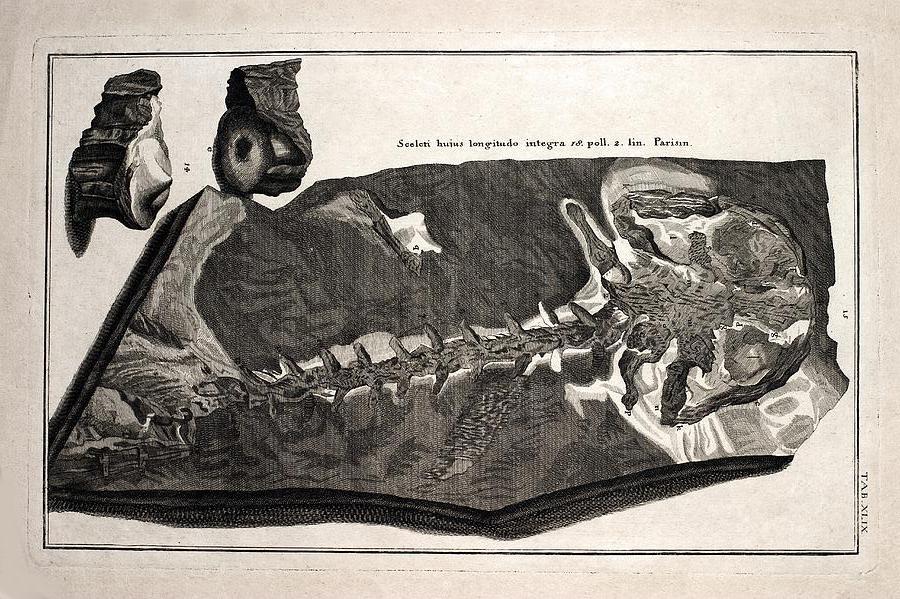
Fossilized giant salamander (Homo diluvii testis = "witness of the Deluge")
Fossilized giant salamander (Homo diluvii testis = “witness of the Deluge”)

Next follows a quick survey of the bones of prehistoric animals mistaken for the bones of biblical Nephilim (or St. Christopher, who was also believed to be a giant from the land of Canaan).  Bones of mastodons figures prominently as do the teeth of St. Christopher, though holy relics produces from beached whales and deceased hippopotami are also mentioned.  We also learn of the patron saint of hares, St. Melangell  (also somehow gifted with oversized bones) a dinosaur named after the human scrotum, and a prehistoric species of giant salamander mistaken for one of the Nephilim by 18th century naturalist Jakob Scheuchzeri, who figures into the early science fiction novel War of the Newts (represented with a snippet from a 2005 BBC radio drama). The  hoaxed 12th-century discovery of a gigantic skeleton of King Arthur at Glastonbury is also discussed.

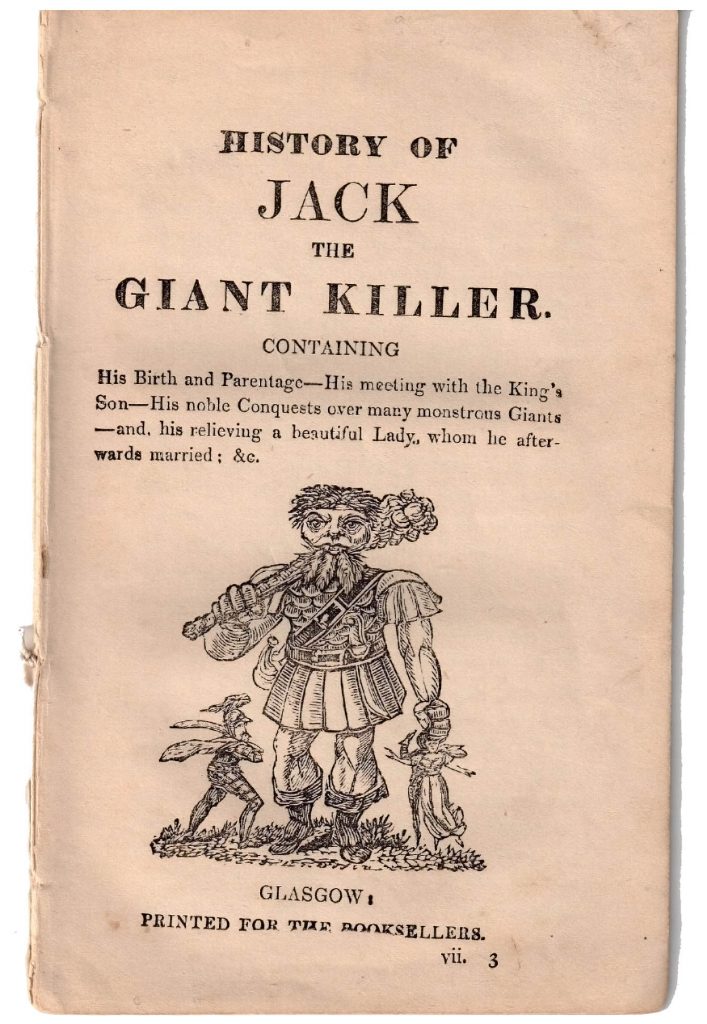
We learn that Arthur turns out to be connected to the Cornish folktale of that murderous scamp “Jack the Giant Killer.” Referring to an 18th-century text, we run through the grisly episodes of this story (including a long-forgotten one including a female follower of Lucifer).  Not only does the original tale see Jack inducted to Arthur’s Round Table, but it seems the Cornish story is a retelling of a similar Arthurian story of the king slaying a giant on Mont Saint Michel in Normandy.  A strangely mirrored version of this site, St. Michael’s Mount in Cornwall also was said to be home to a giant named Corineus, a figure that seems to be related to Cormoran, the first giant killed in “Jack the Giant Killer.”

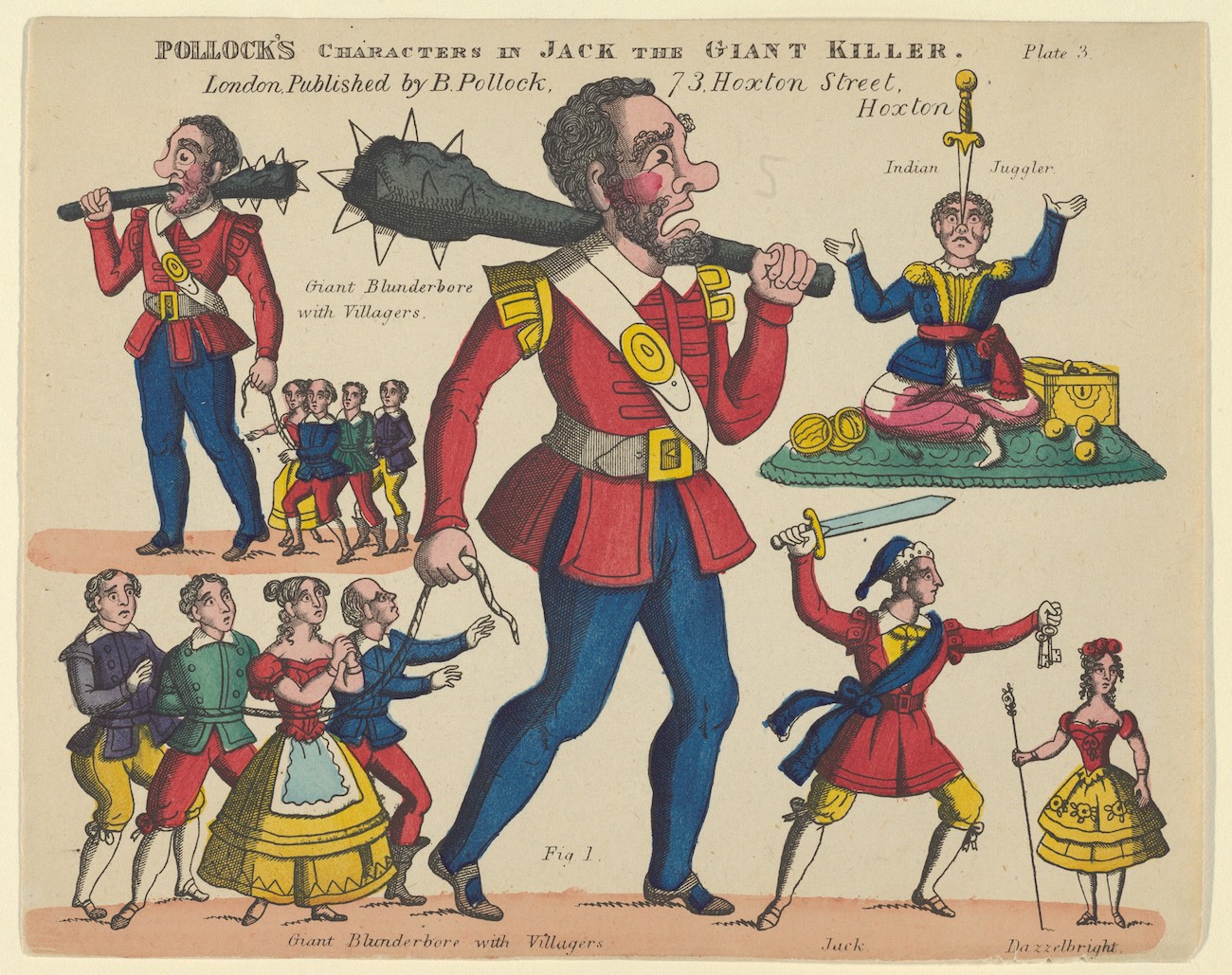
19th-century "toy theater" figures for Jack the Giant Killer (probably as elaborated in a pantomime)
19th-century “toy theater” figures for Jack the Giant Killer (probably as elaborated in a pantomime)

Along the way, Wilkinson provides us some richly detailed passages regarding Arthur’s encounter with the giant of Normandy from the 15th-century telling in The Alliterative Morte Arthure.

On the border between Cornwall and Devon is a site known as “Giant’s Leap,” where another mythic Corineus was said to have killed a giant in the Geoffrey of Monmouth, pseudo-history of Britain, Regum Britanniae.  Monmoth’s fable tells of Britain being founded by Brutus of Troy, sent to the island by the goddess Diana, who foretells his victory over the indigenous giants there.  The last of these giants to die (as we hear dramatized in a reading from the text by Wilkinson) is hurled from the “Giant’s Leap” by one of Brutus’ soldiers — who happens to be named Corineus.  That giant’s name in the text is Gogmagog.

The rest of our story, getting from these two names to the two figures represented at the London Guildhall and Lord Mayor’s Show is a bit complicated.  It’s best listened to in the show, where you’ll also hear how the first offspring born on Britain were the product of exiled female criminals from Troy and incubi — another bit of the fable unfolded in Monmoth’s  Regum Britanniae.